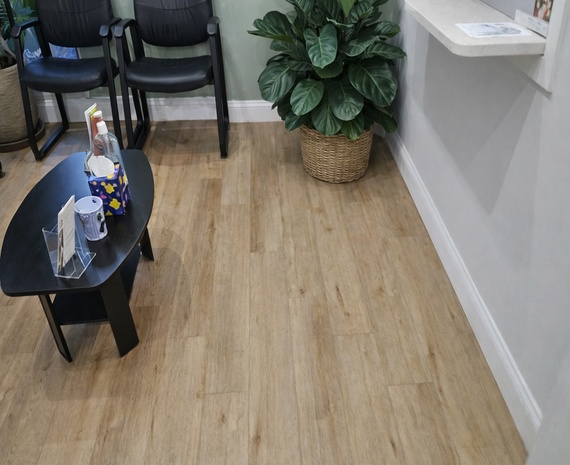
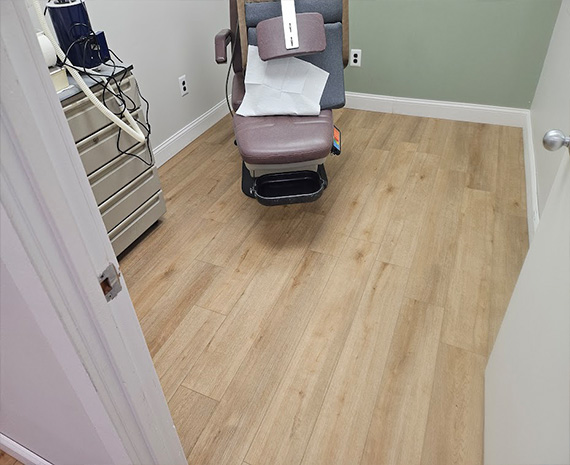
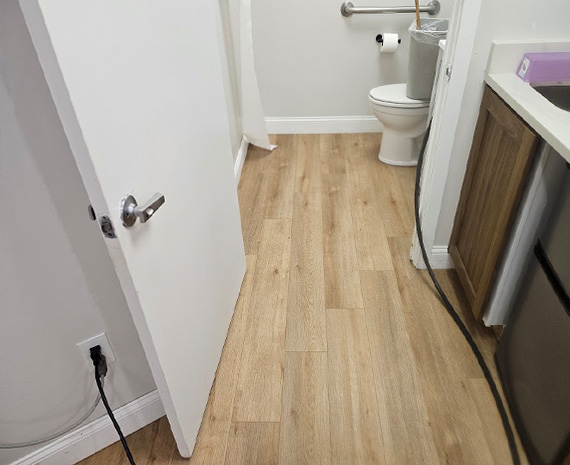
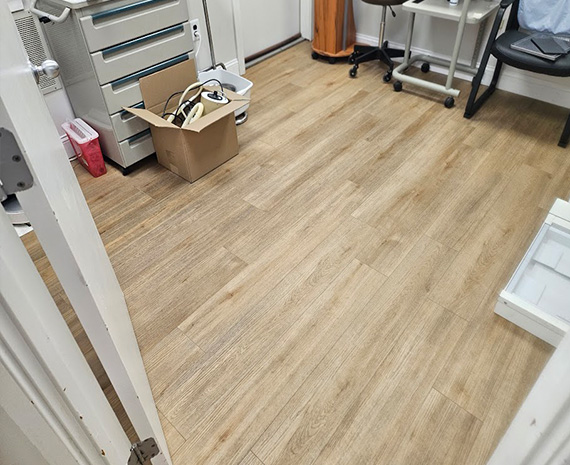
Daily Cleaning. Constant frustration. A floor that never looked clean.
Luxury Vinyl Plank (LVP) is often selected for medical offices because it is durable, moisture-resistant, and easy to disinfect. However, for this podiatry practice, the flooring became an ongoing source of frustration.
The textured, planked-pattern LVP consistently trapped debris. As a result, despite regular cleaning, the floor never appeared truly clean.
Routine cleaning simply wasn’t enough.
Fine dirt, sand, and grit settled into the textured grain. It also got trapped in the beveled edges of the planks. In addition, lightweight debris was also a problem. Visible specs such as paper fibers, lint, and particles tracked in from outside—all became lodged in the surface. Although staff followed a consistent cleaning routine, the floor continued to look dull and dirty. And it was particularly noticeable in high-traffic areas.
Importantly, the concern went beyond appearance
In medical environments, floors that look unclean can quietly raise questions about overall hygiene—even when proper cleaning protocols are in place. In a podiatry practice especially, everything is foot related. So patients are highly aware of their feet and the office floors. Moreover, they are sensitized toward the floors cleanliness. In fact, they are subliminally affected by it. Consequently, the appearance plays a subtle but meaningful role in patient comfort and confidence.
Luxury Vinyl Plank (LVP) is often chosen for medical offices because it’s durable, moisture-resistant, and easy to disinfect. However, for this medical practice, it became a source of daily frustration.
For a deeper look at why textured LVP floors are difficult to maintain in medical, commercial, and residential settings, read our companion article: Why Textured LVP Floors are so hard to keep clean
The Challenge: The floor never responded to routine cleaning
The practice had an established cleaning routine. Daily sweeping and mopping were already part of normal operations. However, the textured surface of the LVP worked against those efforts.
Unlike smooth flooring, textured LVP is designed to replicate natural materials such as wood or stone. While visually appealing, this design creates small valleys where soil collects. As a result, standard flat mopping missed the mark. It primarily made contact with the high points of the floor. This left debris behind in the grain and along the beveled edges.
Over time, this embedded soil accumulated. Therefore, the floor appeared perpetually dirty—even immediately after cleaning. This ongoing frustration ultimately led the practice to seek professional help.
The Environment: Why medical practices are hard on LVP flooring
Medical offices place unique demands on flooring. Podiatry practices are no exception. Throughout the day, patients, staff, and providers move continuously between entrances, exam rooms, treatment areas, and back-of-house spaces. Consequently, fine grit and debris are constantly tracked inside—often too small to notice until buildup occurs.
In addition, footwear varies widely. Patients arrive wearing athletic shoes, work boots, sandals, and slip-on footwear. As a result, soil from parking lots, sidewalks, and surrounding landscaping is frequently introduced. Even with entry mats in place, fine particulate matter easily bypasses these barriers and settles into the floor.
Textured LVP further complicates maintenance. Its embossed grain and beveled edges provide countless small recesses where soil can lodge. In busy clinical settings, foot traffic pushes this debris deeper into the texture. Therefore, routine cleaning becomes increasingly ineffective.
Complicating matters, infection control requirements created problems as well. While disinfectants and sanitizers are essential, overusing them will and did foul the appearance further. Essentially, they are not designed for routine (daily) floor maintenance use.
Over time, repeated use can leave behind residues. Once the water evaporates, these residues create a sticky film. Then the film attracts and holds new surface soils. ( Then the process is repeated, over and over.) Eventually the floor begins to look obscured and smeary (completely undesirable to anyone looking at it). Exactly and also a condition we found that was remediated.
In summation, even diligent cleaning efforts can contribute to a dull, dirty. sticky even smeary appearance.
Our Approach: Addressing the root of the problem
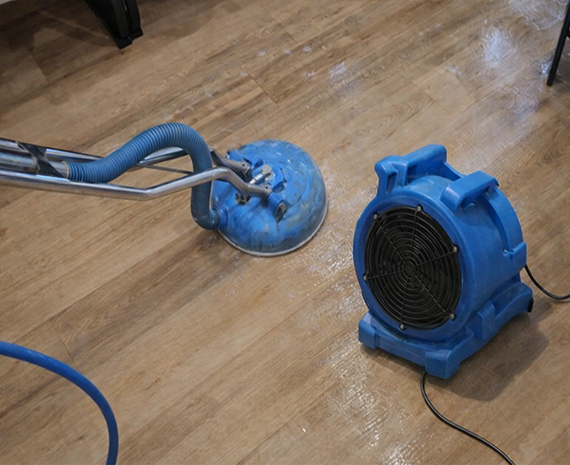
Let’s call what we did a “cleaning refinement and enhancement”. Rather than increasing cleaning frequency or applying more product, the focus shifted soil removal. The goal was simple— remove embedded debris while carefully controlling moisture to protect the integrity of the planks.
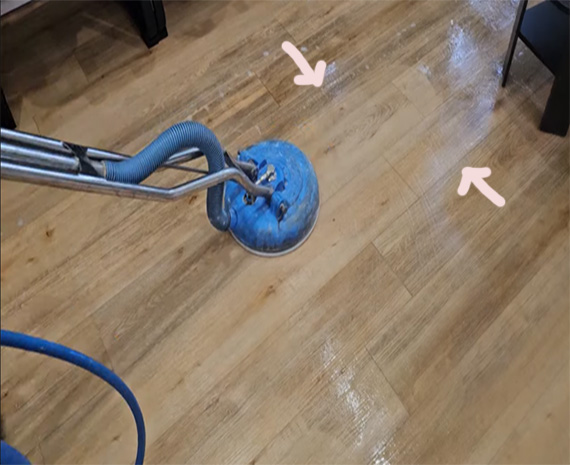
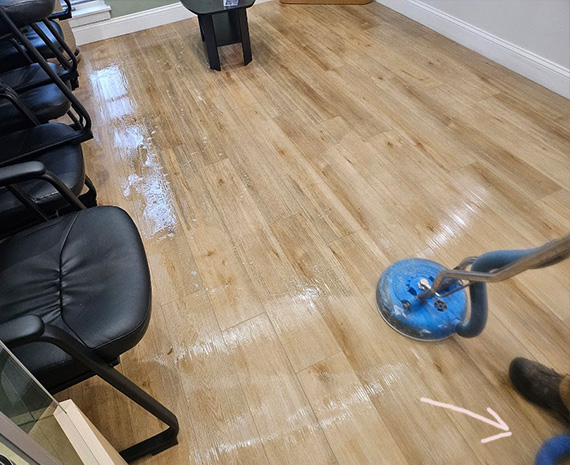
First, the floor was evaluated to identify heavy soil accumulation. So close attention was paid to high-traffic lanes and transition areas. Next, the textured grain and seams were closely examined. It was confirmed that fine grit had settled in areas untouched by routine flat mopping. In other words, the cleaning method was simply gliding over the problem.
A controlled, low-moisture cleaning process was key to the restoration. Using hot water, an appropriate cleaning agent, and gentle mechanical action, the floor was cleaned in small, carefully monitored sections. This approach loosened and lifted embedded soil rather than pushing it deeper into the surface. Finally, the floor was dried and ‘finish’ buffed to prevent moisture migration into seams or beneath the flooring.
The Results: Visible improvement and renewed confidence
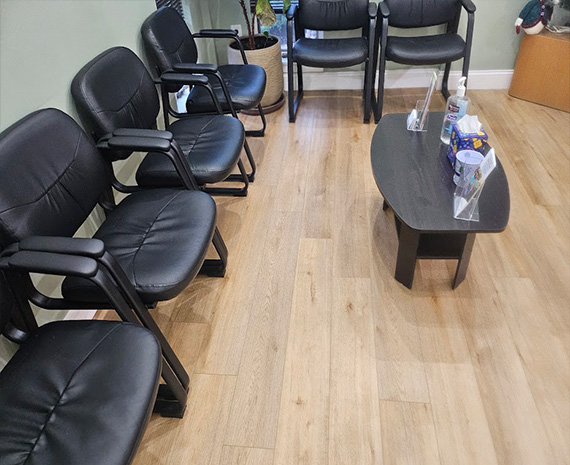
The improvement was immediate and noticeable. The textured surface and beveled edges were free of embedded debris. The high-traffic areas appeared cleaner and more uniform. The dull, gray cast disappeared. The floor now had a natural, well-maintained appearance.
Beyond visual improvement, daily maintenance became more effective and less frustrating. With embedded soil and residue removed, routine cleaning began to work as intended. As a result, the floor stayed cleaner longer and required less effort to maintain.
Most importantly, the restored condition of the floor aligned with the practice’s standards of care. The environment once again reflected the cleanliness, professionalism, and attention to detail patients expect in a medical setting—helping reinforce confidence and comfort from the moment they walked in.
Maintenance Recommendations
To help maintain the restored appearance of the LVP flooring, a revised maintenance plan was recommended—one that matched both the floor’s textured design and the demands of a medical environment.
Key recommendations included: Our perscription moving forward (one step at a time- couldn’t resist, lol!)
-
Daily dry soil removal using a commercial vacuum or microfiber dusting system to remove fine grit before it becomes embedded in the texture. (a discussion of acquring a back-pack style vacuum is encouraged)
-
Daily damp mopping with a microfiber flat mop, using minimal moisture and clean pads changed frequently to avoid redistributing soil.
-
Weekly wet cleaning with a neutral pH floor cleaner and well-wrung mop, taking care to prevent over-wetting and standing moisture.
-
Avoidance of harsh or residue-leaving products, including high-alkaline cleaners, excessive disinfectant use on flooring, and steam cleaning.
-
Periodic professional maintenance to address soil accumulation within the textured surface and beveled edges that routine cleaning cannot reach.
This approach allows the floor to remain visually clean while protecting the integrity of the LVP and supporting infection control protocols.
A team willing to step up (and take the problem head-on)
Credit is due to the practice for recognizing the issue and choosing to address it. Rather than ignoring a persistent problem, they took a proactive approach—seeking a solution that aligned with their standards of care.
By facing the issue head-on, they achieved a visibly cleaner, more hygienic-looking floor. So overall this better reflected the level of care provided within the practice. As a result, patient confidence and trust were reinforced. And the overall appearance of the space supported the practice’s professional image and brand.
At the same time, these adjustments made daily maintenance easier and more effective for staff. In the end, small but thoughtful changes delivered meaningful benefits—for the team, for patients, and for the practice as a whole.
Key Takeaway: The floor wasn’t the problem
The core issue wasn’t neglect or lack of effort. The floor was being cleaned—but not in a way that matched its design.
Textured LVP requires a uniquely specific maintenance program to avoid looking perpetually dirty. The plan needs to account for its grain, bevels, and interaction with fine particulate soil. It needs proper daily techniques. And it needs backup professional periodic corrective support to assure its overall appearance and optimal hygiene.
By addressing the root cause and adapting proper procedures, this medical practice’s floors were restored. Also restored was staff and patient confidence—the practice floors were now clean, and contributed to a hygienically clean environment.
LVP cleaning headaches? Fix the problem—not just the surface. Free Estimates. Call us at 609.953.0472 or CONTACT US ONLINE