

Engineered Wood Refinishing With Micron-Level Precision
- Home Case Studies Engineered Wood Refinishing With Micron-Level Precision
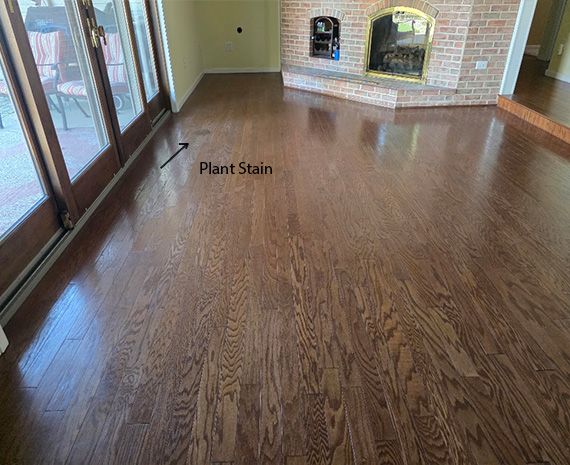 Before refinishing, this engineered hardwood floor showed a dark plant stain, worn finish, and other blemishes that needed correction.
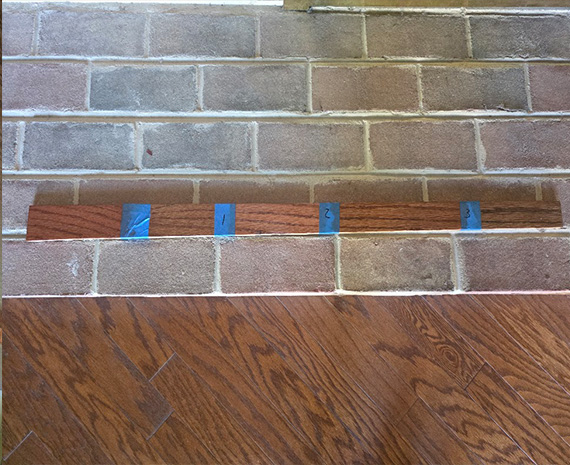 Custom stain and finish samples allowed the homeowners to approve both the color and final sheen before refinishing began.
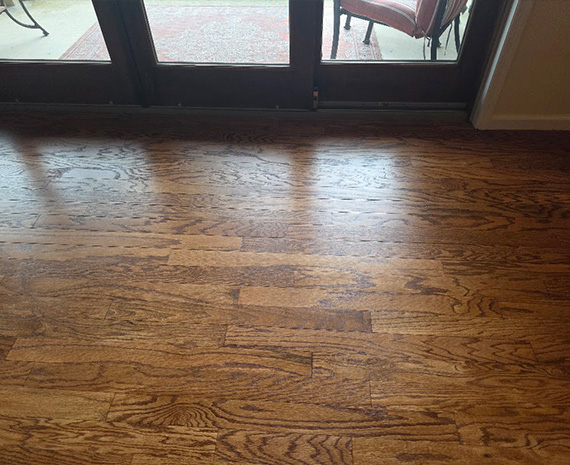 The dark plant stain near the sliding doors was completely removed without over-sanding the engineered wood wear layer.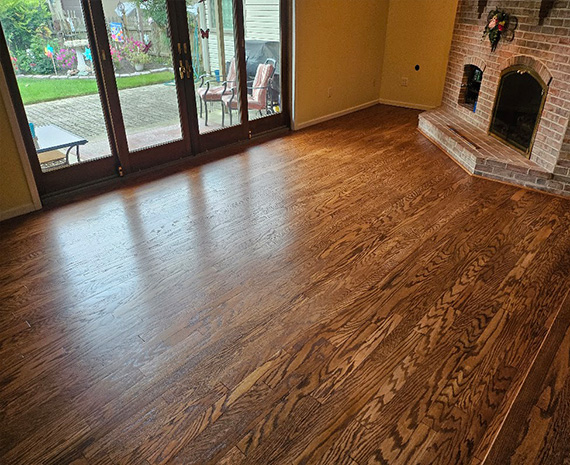
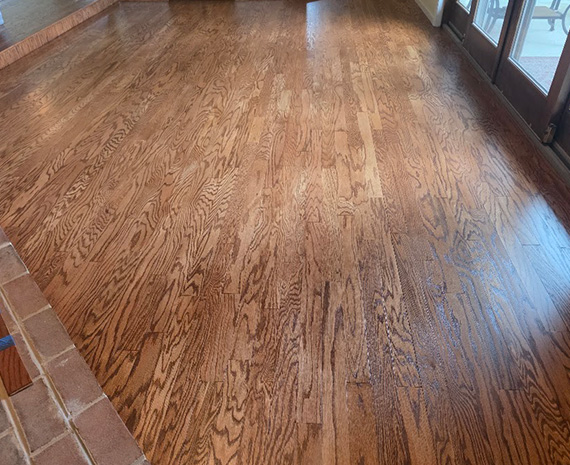
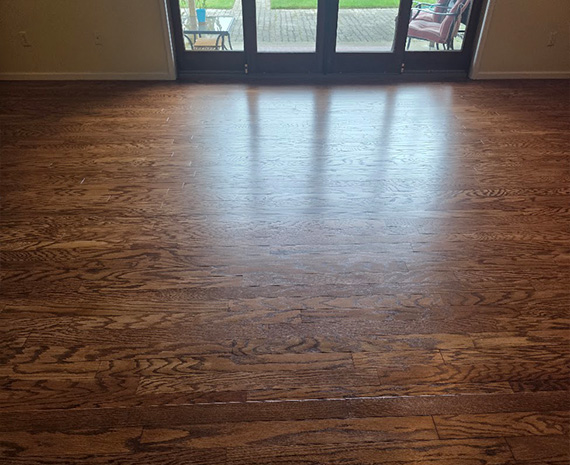 The completed family room floor shows a consistent custom color and satin finish across the engineered hardwood installed over radiant heat.
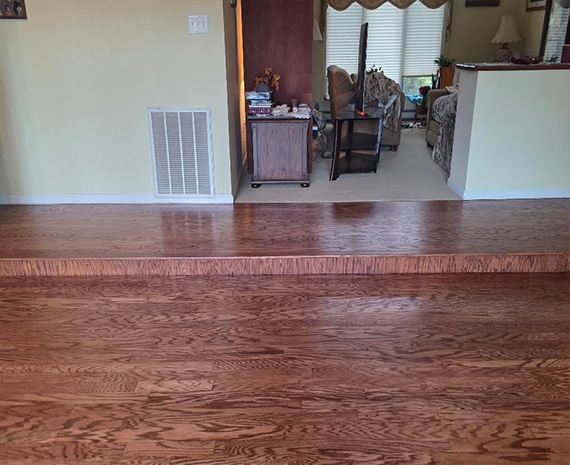 The long family room riser was carefully refinished to coordinate with the main engineered hardwood floor and adjoining hallway.
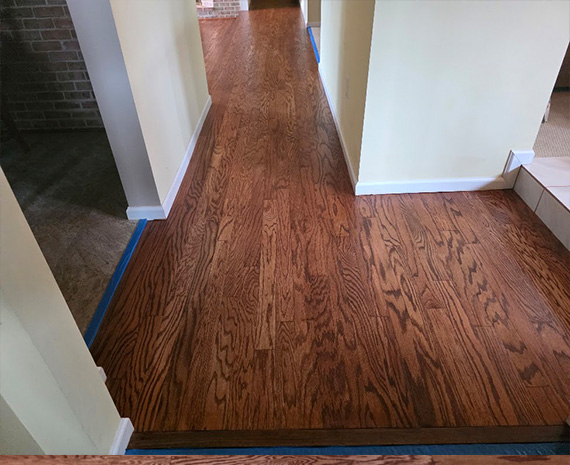 Engineered hardwood over radiant heat was carefully sanded, custom stained, and refinished while preserving the limited wear layer.
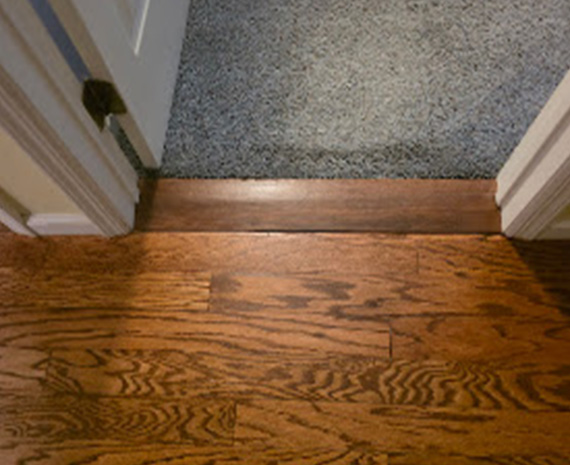 Doorways and thresholds were treated as part of the project, not an afterthought, with each transition refinished to coordinate with the flooring.
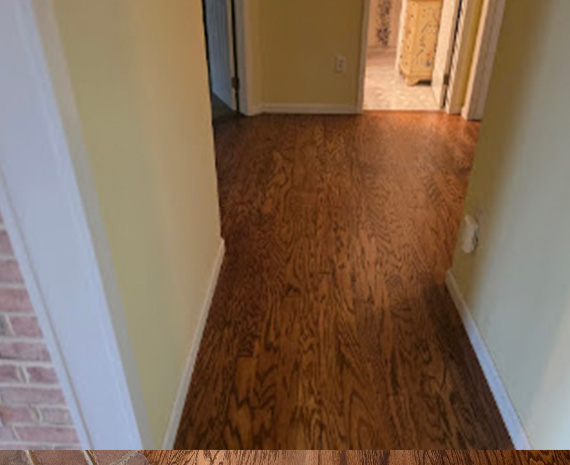 The refinished hallway shows the restored color, grain definition, and even satin appearance achieved throughout the engineered flooring.
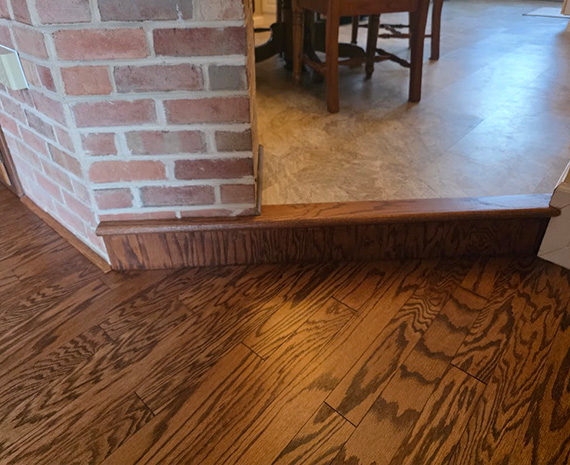 The kitchen riser and stair nosing required careful sanding and stain matching because the wood accepted color differently than the main floor.
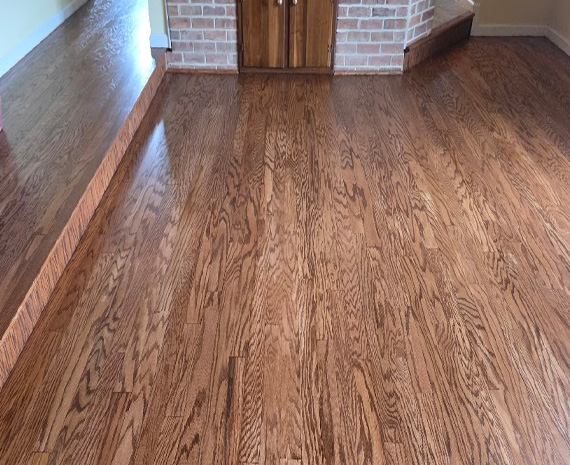 The completed family room shows the refinished engineered hardwood, coordinated risers, and newly stained trim around the aquarium area.
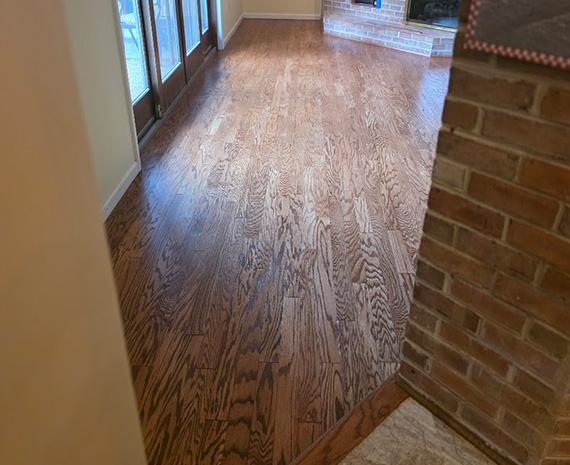 From the kitchen, the restored floor shows how the custom stain tied the main field, thresholds, and adjoining wood elements together.
 The sunken family room, riser, and surrounding engineered hardwood were restored as one coordinated project, with careful attention to every change in elevation.
-
Information:
Location: Mullica Hill, NJ
- Job: Engineered Hardwood Floor Refinishing Over Radiant Heat
Micron-level standards. Zero supervision. Total confidence.
A machinist’s eye, a micron-thin margin for error.
Our client is a machinist, so precision is part of his everyday world. He measures, questions, and inspects details most homeowners would never even notice.
Before we ever touched his engineered hardwood floors, we spent hours discussing the project: how much of the wear layer could safely be removed, how the radiant heat affected the process, how blemishes would be corrected, and how closely the final stain needed to match.
He wanted answers down to the smallest detail — and we gave them to him. What happened next said more about his confidence in us than any compliment could.
After scrutinizing the process, reviewing the agreement, and seeing the stain-and-finish sample with his own eyes, he did something we never expected:
He left for a cruise and trusted us to complete the entire project without supervision.
For a homeowner accustomed to closely monitoring contractors and calling out anything that missed the mark, that level of trust was extraordinary. He was confident that what we explained was exactly what we would execute.
Once Steve and his wife left, the real test began. He believed what we had explained, documented, and demonstrated beforehand was exactly what we would execute in his absence, once he was gone.
The work had to justify the confidence.
And that confidence came with a very specific set of expectations. Before work began, Steve wanted the details clearly defined so there would be no ambiguity about what would happen once the project was underway.
- Protect the home with plastic containment, and control dust throughout the refinishing process.
- Remove doors where appropriate so all five thresholds could be refinished along with the main floor.
- Correct the scratches, water damage, worn areas, and other visible blemishes.
- Carefully refinish the approximately 15-foot riser separating the sunken family room, along with the smaller kitchen riser.
- Confirm that the riser wood would tolerate the sanding and staining process, and blend appropriately with the main field of flooring.
- Address the bullnose stair treads, recognizing that their different wood cut could accept stain differently, and blend them as closely as possible with the surrounding floor.
- Purchase, stain, and install new trim at the base of the aquarium and fireplace hearth so those finishing details coordinate with the restored floor.
With those objectives established, very little was open to interpretation.
The floor had already been evaluated for its limited wear layer. The radiant heat had been factored into the refinishing plan. The custom stain formula had been established and clearly approved. And the sheen had been selected with full understanding of the finished appearance.
There was no room for an aggressive sanding sequence, no room to remove unnecessary material, and certainly no room to damage the thin engineered wear layer or compromise the radiant heating system below.
Now came the part that mattered most. We had to deliver exactly what we said we would!
The Prep: Precision started before the first sanding pass.
Before the refinishing could begin, the home itself had to be prepared for the work ahead. Plastic containment was installed where needed, adjoining areas were protected, and doors were removed where necessary, so the five thresholds could be addressed as part of the floor rather than worked around.
The work.
Then came the most critical part of the project: removing the existing finish without removing more wood than the engineered wear layer could safely surrender.
For this floor, our traditional Lagler Hummel — normally the workhorse of a hardwood refinishing project — was deliberately taken out of the equation. Instead, we relied on the Lagler Trio, whose controlled sanding action allowed us to work gradually and precisely while removing only the material necessary to restore the surface. On a floor with this little margin for error, every pass mattered.
The blemishes had to disappear without sacrificing the floor.
As the old finish was removed, we worked through the scratches, worn areas, and subtle imperfections that had developed over time. Most concerning was the approximately four-inch black water mark near the sliding door. It needed to disappear, but not at the expense of sanding unnecessarily deeper into an already limited wear layer.
Careful, progressive sanding did exactly what we needed it to do. The water mark was eliminated. The scratches and worn-through areas were corrected, and the surface was brought back evenly without overworking the engineered floor beneath it.At the same time, we gave equally close attention to the details Steve had specifically identified beforehand: the long riser separating the sunken family room, the smaller kitchen riser, the thresholds, and the bullnose stair treads.
Because those components were made from different cuts of wood, we could not assume they would sand, absorb stain, or present color exactly like the main field of flooring. Each had to be worked individually, then evaluated as part of the whole.
Then we deliberately slowed the project down.
Once the protective finish had been removed, the wood was temporarily more exposed to the surrounding environment. That mattered.
With radiant heat beneath the floor, along with normal fluctuations in temperature and humidity, this was not a project where we wanted to sand one day and simply race into stain and finish the next. We allowed additional time for the exposed wood to acclimate and stabilize before moving forward.
That extra time was built into the plan intentionally. It gave the floor an opportunity to respond to its temporary exposure, then settle back within appropriate conditions before stain, sealer, and finish were applied.
Sometimes precision means knowing when to work. And sometimes it means knowing when to wait.
The color had already passed its own test.
Because Steve and his wife had approved the complete stain-and-finish sample before leaving, there was no guesswork once we reached the color stage.
The custom stain blend was applied to reproduce the aged color they wanted, rather than simply relying on the original Gunstock formula that no longer represented how their existing floor appeared. Then came the approved sealer and satin finish system — the same combination Steve’s wife had already seen, considered carefully, and personally selected before the cruise.
What they had approved on the sample was now being reproduced across the actual floor.
The finishing details mattered just as much.
As the refinishing moved toward completion, the project did not stop with the field of hardwood. The thresholds, risers, and bullnose treads were blended as closely as their differing wood characteristics would allow. New trim was stained, cut, and installed at the aquarium and fireplace hearth, and the doors that had been removed for proper access were reset.
Those may sound like finishing touches. For this homeowner, they were part of the job. And for us, they were part of delivering exactly what we had promised.
Then came the real test: Steve came home.
By the time Steve and his wife were returning from their cruise, the project was essentially complete. The engineered hardwood had been restored. The black water mark was gone. The scratches and blemishes had disappeared. The custom color was on target, and the satin finish they had approved was exactly where it needed to be.
But completing the main field of flooring was never going to be enough.
The five thresholds had been refinished. The long family room riser and smaller kitchen riser had been carefully worked to coordinate with the floor. The bullnose stair treads had been addressed with consideration for their different wood characteristics, and the new trim at the aquarium and fireplace hearth had been stained, cut, installed, and finished to become part of the completed project.
The doors were back in place.
In other words, Steve wasn’t coming home to a beautiful floor surrounded by a list of loose ends. He was coming home to the job he expected us to complete.
The photographs looked good, but the inspection still mattered.
On the way home, Steve and his wife had already seen photographs of the finished floors, and they were thrilled with what they saw.
Still, we knew photographs were one thing. Steve walking through the house with a machinist’s eye was another.
This was the homeowner who had measured, questioned, and examined the project before it ever began. He understood tolerances. He noticed small variations. And, based on previous experiences with other contractors, he was accustomed to finding things that needed to be corrected.
So when he returned home, we knew the project was about to face its final inspection.
The floor passed with flying colors.
Steve looked. And looked closely.
The water mark that had concerned him was gone. The blemishes had been corrected. The engineered wear layer had been preserved. The custom stain blend produced the color he and his wife had approved, and the satin sheen delivered the appearance she had knowingly selected.
Then came all of those other details that mattered just as much to him. The thresholds blended. The risers coordinated. The bullnose treads complemented the field of flooring. The new trim looked like it belonged there, and the doors were reset.
There was no correction list waiting for us. No “come back and take another look at this.” No compromise that Steve had to reluctantly accept.
For a homeowner who openly admitted that he had routinely needed to stay on top of contractors to get the results he expected, that absence of a callback said plenty.
The outcome was bigger than a refinished floor.
Perhaps the most remarkable part of this project was not that we successfully refinished a difficult engineered hardwood floor. It was that a homeowner whose professional life revolves around extremely tight tolerances became confident enough in our process to surrender control of the project altogether.
He asked the questions first. We answered them.
He measured. We explained.
He challenged the process, and we documented exactly how we intended to approach it.
Then he and his wife boarded a ship, enjoyed their vacation, and trusted us to do what we said we would do. When they returned, there was nothing to babysit, nothing to dispute, and nothing to send us back to correct.
The floor — and our work — had passed the machinist’s test.
The takeaway: when there is little room for error, experience matters.
Not every engineered hardwood floor can be refinished. And because they often can’t, you must only trust an expert with a trained eye and experience to determine if your floor can. Can You Sand and Refinish Engineered Hardwood Floors?
Even when one can, a limited wear layer may leave very little room for an aggressive sanding process or an inexperienced approach. Add radiant heat, water damage, multiple wood components, a demanding color match, and exact expectations, and every decision matters.
To sum it up with hardwood floor refinishing (and Steve knew it)…
- The equipment matters.
- The sanding sequence matters.
- The conditioning matters.
- The stain and finish system matters.
And perhaps most importantly: the willingness to listen, plan, and execute the details matters.
Because sometimes the greatest measure of confidence isn’t what a client says before the work begins. It is knowing all the t’s were crossed and the i’s were dotted, every reason why Steve was in fact able to board the ship without wondering what he would come home to.
In fact, Steve and his wife did board the ship. They fully enjoyed their cruise. They worked out, enjoyed great meals and shows, and let the cruise fully take their minds off what was happening back home.
Steve never micromanaged the project from the ship. His only call came shortly before their return, simply to confirm where things stood and whether anything unusual would need their attention when they got home.
When they returned, there was nothing to babysit, nothing to dispute, and nothing to send us back to correct. In fact, so pleased the crux of Steve’s follow-up call focused entirely on how best to forward a gratuity to Marvin, our wood floor technician!
In the end, Steve and his wife got exactly what they had hoped for: beautifully restored floors, confidence in the process, and a vacation they were actually able to enjoy without managing the project from afar.
For a homeowner who measures details in microns, that may have been the clearest measure of success of all.
And their appreciation was also reflected in an unexpected gratuity for our team — a thoughtful gesture that spoke volumes about how pleased they were with the finished project.