
Historic Wood Floor Restoration at St Mary’s Burlington
- Home Case Studies Historic Wood Floor Restoration at St Mary’s Burlington

- Info: Location: Burlington, NJ
-
Project:
Historical Hardwood Floor Refinishing
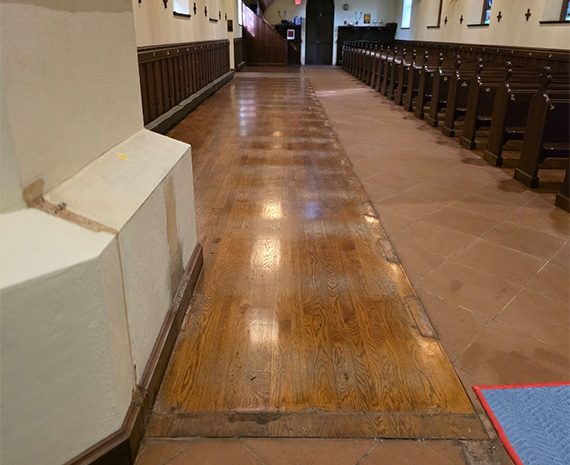
Before the work.
Restoring wood floors inside a historic place of worship requires more than knowing how to refinish a floor. At St. Mary’s Episcopal Church in Burlington, NJ, preservation, trust, and experience were equally important.
Having already cared for the church’s limestone and VCT floors, Sparkle Surface Care was familiar to its leaders. Still, before entrusting us with the historic “Old Church,” they wanted reassurance that our team understood vintage materials and preservation-minded work.
That validation came from several directions. Longtime parishioners, the Quinn family, referred us after having their own floors restored. Church leaders also reviewed our work in historic homes throughout Riverton, Burlington, and neighboring river towns.
In addition, SSC had previously provided wood care for the Burlington County Historical Society at its historic 459 High Street property, and stone restoration inside Philadelphia’s historic Masonic Grand Lodge. Together, those projects demonstrated something important: we had been trusted to work carefully within historically significant properties.
Preparing the sanctuary.
The preparation was carefully planned and expertly handled.
Before the first sanding pass ever began, careful planning was already underway. The pews were pre-labeled so each could be returned to its precise location, and we referred Olympia Moving to the church to assist with the highly coordinated move. Spearheaded by Patrick Sipera, The Olympia Moving Team carefully disassembled, moved, and staged the pews within the sanctuary, allowing the restoration to proceed in phases without removing these important furnishings from the property.
At the same time, the baseboard heating covers were methodically disassembled so our wood team could properly access the edges beneath and around them. Their removal also created an opportunity for years of dust, debris, cobwebs, and even the occasional lost church offering to be cleaned from the registers. Church volunteers then washed and prepared the covers for re installation, making the process a true collaborative effort between the church, the moving team, and our restoration crew.
Timing was equally deliberate. Less humidity was preferred.
With no air conditioning in the Old Church, we waited until summer’s extreme heat and humidity subsided. We had hoped for more cooperative weather, and as the work launched, Mother Nature delivered. Thankfully, the heat and humidity did back down. It was more pleasantly cool and less humid.
The work.
Staging the work. Respecting the grounds.
With things falling into place, we got the work site staged and set up. Father allowed us to position our trailer right outside the north entrance to the old church. Around it were prominent resting places (headstones) for church elders: bishops
Even the placement of our equipment required careful thought. Old St. Mary’s is surrounded by its historic churchyard, where generations of parishioners, clergy, bishops, veterans, and prominent early Americans are laid to rest. With that history literally surrounding the building, our trailer and work area had to be positioned with the same respect and care being given to the sanctuary itself.
That setting is an important part of the story. Historic churchyard records, early documents, and present-day views of the grounds all help illustrate that this restoration was taking place within a living piece of Burlington history—not simply inside an older building.
The work began- sanding.
With the sanctuary prepared, the restoration itself could begin. Because this was vintage wood in a historically significant setting, the goal was never aggressive removal. Instead, every sanding pass was approached with restraint, control, and an understanding that the existing wood needed to be preserved for the future, not simply made to look new.
The first sanding pass was completed with our Lägler Hummel to remove the worn finish and damaged surface layer. From there, our Lägler TRIO and FLIP were used for the finer stages of sanding, allowing our wood team to gradually refine the floor while removing only the minimal amount of sacrificial wood necessary.
That distinction matters greatly with older flooring. A floor can always be sanded again, but wood that is removed can never be put back. Therefore, our craftsmen continually evaluated the surface, the remaining wear layer, and the response of the wood as the restoration progressed.
Edges, corners, and areas around the exposed heating components also required detailed hand work and specialized sanding. Rather than treating the sanctuary as one large open floor, each area was addressed according to what the wood itself required. The result was a clean, even surface ready to accept stain, while preserving as much of the historic material as possible.
All work was completed with precision, detail, and a careful review and eye on all the wood surfaces. Prior to the staining process the wood was “water-popped” to flush out and reveal any imperfections in the sanding. And duly, it would also open the grain further to allow better and even absorption of the stain across the wood surface. So while this was taking place, the preferred stain choices were presented to Barbara and Father Hayes, for their selection.
Choosing the right stain.
Once the sanding was complete, the next decision was color. Barbara and Father Hayes wanted a mid-tone stain—nothing too dark, too light, too yellow, or too orange—that would complement the already restored areas of the church and the surrounding historic woodwork.
Rather than relying on a sample board, we prepared stain samples directly on the church floor. Some were viewed in the center of the sanctuary, where the natural light is limited, while others were placed closer to the rear doors, where daylight could influence the appearance of the color.
That allowed Barbara and Father to see how each option behaved in both settings. Ultimately, Father agreed with Barbara’s preference, and the selection was made with confidence. It was: (Dura Seal) “Golden Brown”.
With the color approved, the first half of the sanctuary was stained. The tone settled beautifully into the wood, bringing warmth back to the floor while remaining balanced against the darker architectural elements throughout the church.
At this point in the restoration, the stain application progressively moves the project to the next stage: staining, sealing and final finish coats.
Staining, after precise sanding, is the most critical procedure.
With a tag team duo, Marvin and Carlos prepared the stain recipe (or ratio). They mixed enough stain for the entire project, then applied the precise blend to the first section. The remaining stain was kept and stored properly for use after the second part of the work as ready (i.e., the other side of the sanctuary, after those pews were carefully disassembled by the Olympia team.
After mixing, the stain was hand-applied and wiped with precision. Using a team of two allowed for this work to be done carefully, while checking the work and having a backup person available for any assistance. At completion, a full 12+ hours of curing was built into the schedule, and the church staff was cautioned to stay off the stained areas.
Homestretch: sealing and finish coats. And A side-bar about the company whose PolyWhey™ finish products are something to learn about!
With the stain fully cured as per manufacturer specs, the seal was applied early the next morning, with 6+ hours of cure time. Then the team returned late afternoon and applied the first finish coat of water-based finish made by Vermont Natural Coatings.
This coating system is an excellent coating system that is “clean water certified” and suitable for high-traffic, commercial use. The bottom line: this finish system is a non-toxic, non-carcinogenic, and low voc finish system. Furthermore, it has been tested over time and used all over the world. For our purposes, we prefer using this due to its positive performance characteristics. And we are also strong proponents of using it because it is a safer coating formulation.
If you aren’t interested in the source of the finish system skip this next paragraph: but you might like learning about it…(it is impressive!…)
A Side-Bar: About Shelburne Farms Organic Dairy Farm, Poly Whey™ the sustainable invention…
This is a very good story about all the good things, including floor finish that they bring in from pasture for sustainable and conscientious use!
(To learn more about “VNC’s mission, using whey, a by-product of cheese making using an exceptional finish system that is better chemistry without exposing anyone click here…. Likewise, if you want to learn more about Poly Whey™, the product we used, and about its development, check this out….
And if you want a real “feel good” story about the happy cows journey from the pasture to the floor finish check this impressive Northern Vermont Dairy Farm out! Andrew Meyer, owner of Shelburne Organic Dairy Farm, is a visionary inventor whose story is something to learn about! The cow’s story is notable. And everything about the farm is too! (You can get married there, dine and stay over, visit their education center, cheese shop, take a walking tour, and more!)
So for us, using this finish system is a terrific whey™ to refinish hardwood floors knowing we aren’t using toxic chemicals to do our work, or introduce it to others utilizing the space and structure! Want to learn more about this awesome farm? Stop by Shelburne Farms and pay them a visit!
Okay: The “finishing” home stretch…
With just a few hours between finish coats, this went quickly! Meanwhile, before the pews went back, Barbara and Father Hayes summoned a group of parishioners to wash the baseboard vent covers (which were dirty, loaded with cobwebs, and even a few lost offerings or two- pennies & chump change (lol). Some teamwork got the covers clean!
And after Olympia reset the first group of pews, a few days later, so did the sanding and finishing of the second half of the sanctuary floors.
The results.
After a collaborative effort, we got the floors sanded! They look pristine and freshly coated. The careful planning and partnering with Olympia paid off huge dividends. The sanctuary interior was respected. The pews and baseboard vent covers were carefully removed, and then reset. The hardwood floors were protected while the resetting took place. And everything went back as it belonged.
To sum it up, with all the other magnificent architecture, the sanctuary, its hardwood floors, pew seating, and such is about to go back into service for this wonderful parish! If you want to see the results, or more importantly, if you want to experience the impressive historical church and its history, I, on behalf of St. Mary’s, invite you to go visit them to experience it firsthand… See the history yourself, oh, and by the way if you do tell them how gorgeous their hardwood floors look!